
Sale!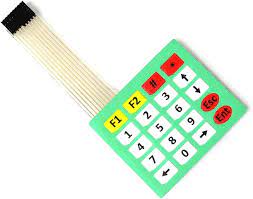
4×5 Matrix Array 20 Keys Membrane Switch Keypad Keyboard For Arduino COM52 ,R14
$ 90.60
DescriptionThis 4×5 Matrix Array 20 Key Membrane Switch Keypad Keyboard high-quality soft-touch feeling button keypad with 100 million life-stroke lifespans and good resistance to environmental conditions.This 20-button keypad provides a useful human interface component for microcontroller projects. Convenient adhesive backing provides a simple way to mount the keypad in a variety of applications.Features :Ultra-thin design & adhesive backing provides easy integration to any projectExcellent price-performance ratioEasy communication with any microcontroller5 pins 2.54mm pitch connector, 4×5 type 20 keys.The sticker can peel off for adhesive mounting.Used widely in industrial and home electronic equipment, instrument, etc.This allows a microcontroller to ‘scan’ the 9 output pins to see which of the 20 buttons is being pressed.SpecificationGetting started with the 20 Key Membrane Switch Keypad Keyboard 4×5 Matrix ArrayWe are going to show how to connect a 4×5 Matrix Array 20 Key Membrane to an Arduino.Step1: Hardware requiredArduino Uno4×5 Matrix Array 20 Key MembraneStep2: Connecting the HardwareThe connections are pretty straightforward. Start by connecting pin 1 of keypad to digital pin 10 on Arduino. Now keep on connecting the pins leftwards like 2 with 9, 3 with 8 etc.Step3: Upload the CodeFirst downoad keypad.h library here.#include <Keypad.h> const byte ROWS = 5; //5 rows const byte COLS = 4; //4 columns char* specialKeys[] ={ "*", "#", "F2", "F1", "UP", "3", "2", "1", "DOWN", "6", "5", "4", "ESC", "9", "8", "7", "ENTER", "RIGHT", "0", "LEFT" };char specialKeysID[] = { 'A', 'B', '#', '*', '1', '2', '3', 'C', '4', '5', '6', 'D', '7', '8', '9', 'E', 'F', '0', 'G', 'H' };char keys[ROWS][COLS] = { {specialKeysID[0], specialKeysID[1], specialKeysID[2], specialKeysID[3]}, {specialKeysID[4], specialKeysID[5], specialKeysID[6], specialKeysID[7]}, {specialKeysID[8], specialKeysID[9], specialKeysID[10], specialKeysID[11]}, {specialKeysID[12], specialKeysID[13], specialKeysID[14], specialKeysID[15]}, {specialKeysID[16], specialKeysID[17], specialKeysID[18], specialKeysID[19]} }; byte rowPins[ROWS] = {2,3,4,5,6}; //connect to the row pinouts of the kpd byte colPins[COLS] = {7,8,9,10}; //connect to the column pinouts of the kpd Keypad keypad = Keypad( makeKeymap(keys), rowPins, colPins, ROWS, COLS ); unsigned long loopCount; unsigned long startTime; String msg; void setup() { // 5x4 keypad test Serial.begin(9600); Serial.println("FARANUX ELECTRONICS"); } void loop() { // 5x4 keypad test char key = keypad.getKey(); // just print the pressed key if (key){ Serial.print(getKey(key)); } if(getKey(key) =="ENTER") { Serial.println("ENTER is pressed"); } //5x4 keypad detecting string value } // End loop /* * getKey() * @brief gets the actual key value from single character * @param k is character * @return returns acualt key value * on May 06, 2020 at 19:37 in Ajax, Ontario, Canada */ char* getKey(char *k) { //5x4 keypad detecting string value for(int i=0; i<20; i ) { if(specialKeysID[i] ==k) return specialKeys[i]; } }//getKeyPackage includes: 1×20 Key Membrane Switch Keypad Keyboard
Related products
-
Garnet Quadruple Faceted Sterling Silver PendantSelect options
This product has multiple variants. The options may be chosen on the product page
-
Garnet Faceted Bead BraceletSelect options
This product has multiple variants. The options may be chosen on the product page
-
Garnet Faceted Bead EarringsSelect options
This product has multiple variants. The options may be chosen on the product page
-
Garnet Oval Faceted Sterling Silver PendantSelect options
This product has multiple variants. The options may be chosen on the product page