
Sale!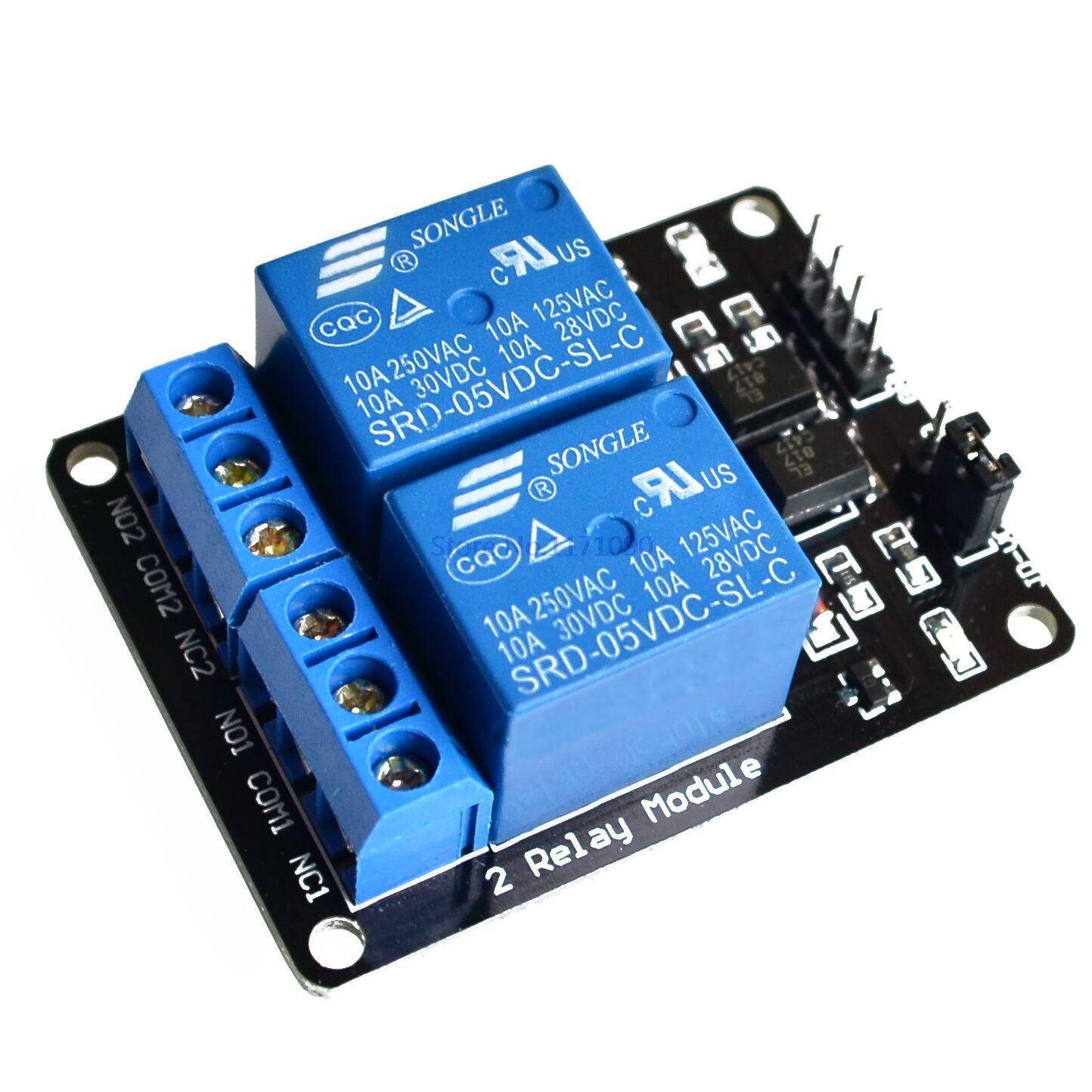
2 Channel 5V Relay Module MOD31 ,R12
$ 95.77
DescriptionTrue hardware automation means moving beyond lighting up small LEDs and stepping into the world of physical power. The 2 Channel 5V Relay Module is the standard workhorse for home automation, allowing your tiny 5V microcontroller to safely dictate the flow of dangerous 220V AC mains power.Whether you are designing a smart greenhouse that needs to automatically trigger irrigation pumps and heat lamps, or equipping workstations for the Electronics Bootcamp, this module is an absolute necessity for safe high-power switching.Optocoupler Isolation (The Safety Barrier)When dealing with AC mains power or heavy inductive loads (like motors), massive voltage spikes can easily kick back up the control wires and instantly vaporize your Arduino. To prevent this, this module features built-in optocouplers (the small black 4-pin chips near the input pins). These chips transfer your trigger signal using a microscopic internal beam of light rather than a physical wire. This means there is absolute electrical separation between your low-voltage logic side and the high-voltage relay coils.Understanding the Screw Terminals (NO / COM / NC)Each of the two blue relays features a robust 3-pin screw terminal block for wiring your high-voltage appliance:COM (Common): The main power wire coming from your wall or battery connects here.NO (Normally Open): Connect your appliance here if you want it to be OFF by default, and only turn on when you send a signal to the relay.NC (Normally Closed): Connect your appliance here if you want it to be ON by default, and only turn off when you trigger the relay (acting as a kill switch).Active Low TriggeringImportant Programming Note: Most of these standard modules operate on Active Low logic. This means that writing a HIGH command to the control pin actually turns the relay OFF. To activate the relay and turn your appliance ON, you must write a LOW (0V) command to the respective IN1 or IN2 pin. Onboard red and green LEDs will clearly indicate when a channel is active.Key Features:Dual Control: Two completely independent relays allow you to control two separate appliances (e.g., a fan and a heater) from the same compact board.JD-VCC Jumper: Allows you to power the relay coils from a completely separate power supply than your microcontroller for true, 100% galvanic isolation.Durable Contacts: The internal contacts of the Songle relays are rated for up to 100,000 mechanical switching cycles.Technical Specifications:Relay Model: SRD-05VDC-SL-C (or compatible equivalent)Trigger Voltage (VCC): 5V DCTrigger Current: ~15mA to 20mA per channelMaximum AC Load: 10A @ 250V AC / 125V ACMaximum DC Load: 10A @ 30V DC / 28V DCIsolation: Optical (Optocoupler)Dimensions: ~50mm x 38mm x 17mmIdeal Applications:Smart home IoT lighting and appliance controlAutomated agriculture (switching 12V/24V solenoid valves and AC water pumps)Industrial automation prototypes and motorized gate controllersEducational labs demonstrating high-voltage isolation and electromechanical switchingGetting started with the 2 Channel 5V Relay ModuleIn this guide you will set up the 2 channel relay module to control 2 LED’s .Hardware requiredArduino Uno2 Channel 5V Relay ModuleJumper wiresUpload the sample code#define RELAY1 2 #define RELAY2 3 void setup(){ pinMode(RELAY1, OUTPUT); pinMode(RELAY2, OUTPUT); } void loop(){ digitalWrite(RELAY1,LOW); // Turns ON Relays 1 delay(500); // Wait digitalWrite(RELAY1,HIGH); // Turns Relay Off digitalWrite(RELAY2,LOW); // Turns ON Relays 2 delay(500); // Wait digitalWrite(RELAY2,HIGH); // Turns Relay Off }Testing the circuitWhen a low level is supplied to signal terminal of the 2-channel relay, the LED at the output terminal will light up. Otherwise, it will turn off. If a periodic high and low level is supplied to the signal terminal, you can see the LED will cycle between on and off.
Related products
-
Garnet Quadruple Faceted Sterling Silver PendantSelect options
This product has multiple variants. The options may be chosen on the product page
-
Garnet Micro Bead Stretchy BraceletSelect options
This product has multiple variants. The options may be chosen on the product page
-
Garnet Triple Sterling Silver Ring; size 7Select options
This product has multiple variants. The options may be chosen on the product page
-
Garnet Micro Bead EarringsSelect options
This product has multiple variants. The options may be chosen on the product page